Abstract
Optical fiber attenuation is a fundamental parameter that determines the efficiency and reliability of optical communication systems. Understanding how attenuation varies with transmission wavelength is essential for optimizing fiber optic links, particularly in long-distance and high-capacity networks. This study presents an experimental investigation of wavelength-dependent attenuation in optical fibers, focusing on commonly used telecommunication windows at 850 nm, 1310 nm, and 1550 nm. The experimental setup consists of an optical fiber link, optical sources operating at the selected wavelengths, and a calibrated optical power meter. For each wavelength, the input optical power and the output power after propagation through a fixed length of optical fiber were measured. The attenuation coefficient was then calculated in decibels per kilometer using standard logarithmic relations. Care was taken to minimize connector and coupling losses in order to ensure measurement consistency. The results reveal a clear dependence of optical attenuation on wavelength. Higher attenuation values were observed at 850 nm, primarily due to increased Rayleigh scattering effects at shorter wavelengths. At 1310 nm, the attenuation was significantly reduced, corresponding to one of the low-loss transmission windows of silica fibers. The lowest attenuation was recorded at 1550 nm, confirming this wavelength band as the most suitable for long-distance optical transmission. The experimental findings are in good agreement with theoretical expectations related to material absorption and scattering mechanisms in optical fibers. This study highlights the importance of wavelength selection in fiber optic communication system design. The simplicity of the experimental approach makes it suitable for educational laboratories and preliminary performance evaluations, while the results provide practical insight into the physical mechanisms governing optical losses. Overall, the work confirms that operating at longer wavelengths significantly improves transmission efficiency and supports the widespread use of the 1310 nm and 1550 nm bands in modern optical networks.
Keywords
Optical Fiber, Attenuation, Wavelength, Optical Losses, Fiber Optics Communication
1. Introduction
Optical fiber communication has become the backbone of modern telecommunication systems due to its high bandwidth, low transmission loss, and immunity to electromagnetic interference.
| [1] | G. P. Agrawal, Fiber-Optic Communication Systems, 5th ed., New York, NY, USA: Wiley, 2012. |
| [2] | J. M. Senior, Optical Fiber Communications: Principles and Practice, 3rd ed., Upper Saddle River, NJ, USA: Pearson, 2009. |
| [4] | J. Hecht, Understanding Fiber Optics, 5th ed., Boston, MA, USA: Pearson, 2015. |
[1, 2, 4]
The continuous growth of data traffic driven by internet services, cloud computing, and multimedia applications has increased the demand for efficient and reliable optical transmission technologies. Among the various parameters that influence the performance of optical fiber links, attenuation remains one of the most critical factors, as it directly limits transmission distance and signal quality.
| [3] | A. K. Ghatak and K. Thyagarajan, Introduction to Fiber Optics, Cambridge, UK: Cambridge University Press, 1998. |
| [5] | M. N. Islam, “Rayleigh scattering in optical fibers,” J. Lightwave Technol., vol. 5, no. 4, pp. 718–723, Apr. 1987.
https://doi.org/10.1109/JLT.1987.1075481 |
[3, 5]
Attenuation in optical fibers refers to the gradual loss of optical power as light propagates along the fiber. This loss arises from several physical mechanisms, including material absorption, Rayleigh scattering, and bending losses. In silica-based optical fibers, Rayleigh scattering is particularly significant at shorter wavelengths, while absorption losses are influenced by material impurities and molecular vibrations.
| [4] | J. Hecht, Understanding Fiber Optics, 5th ed., Boston, MA, USA: Pearson, 2015. |
| [6] | D. Marcuse, Theory of Dielectric Optical Waveguides, 2nd ed., San Diego, CA, USA: Academic Press, 1991. |
| [7] | S. O. Kasap, Optoelectronics and Photonics: Principles and Practices, 2nd ed., Upper Saddle River, NJ, USA: Pearson, 2013. |
[4, 6, 7]
As a result, attenuation is strongly dependent on the operating wavelength, leading to the identification of specific low-loss transmission windows in optical fibers. Historically, three main wavelength regions have been widely used in fiber optic communication systems: 850 nm, 1310 nm, and 1550 nm. The 850 nm window is commonly employed in short-distance and multimode fiber applications due to the availability of low-cost light sources and detectors, despite its relatively high attenuation. The 1310 nm window offers lower attenuation and near-zero chromatic dispersion in standard single-mode fibers, making it suitable for medium-distance transmission. The 1550 nm window provides the minimum attenuation in silica fibers and is therefore preferred for long-haul and high-capacity optical networks, particularly when combined with optical amplification technologies. Understanding the relationship between attenuation and wavelength is essential for the design and optimization of optical fiber communication systems. Although this dependence is well established theoretically, experimental validation remains important, especially in educational and applied laboratory environments. Simple experimental studies allow for a clearer interpretation of loss mechanisms and provide practical insight into fiber performance under real operating conditions. In this context, the present work aims to experimentally investigate the effect of optical wavelength on attenuation in an optical fiber link. Measurements are conducted at 850 nm, 1310 nm, and 1550 nm, and the corresponding attenuation coefficients are evaluated and compared. The results are discussed in light of theoretical expectations, highlighting the role of wavelength selection in improving transmission efficiency and system performance.
2. Mathematical Modeling Phase Masks
The attenuation of an optical signal propagating through an optical fiber can be mathematically modeled as a function of transmission distance and operating wavelength. As light travels along the fiber, its optical power decreases due to intrinsic and extrinsic loss mechanisms. These losses can be described using exponential and logarithmic models commonly adopted in fiber optics.
2.1. Power Propagation Model
Let
denote the optical power launched into the fiber at wavelength
, and
the optical power measured after propagation over a fiber length
.
| [1] | G. P. Agrawal, Fiber-Optic Communication Systems, 5th ed., New York, NY, USA: Wiley, 2012. |
| [2] | J. M. Senior, Optical Fiber Communications: Principles and Practice, 3rd ed., Upper Saddle River, NJ, USA: Pearson, 2009. |
| [6] | D. Marcuse, Theory of Dielectric Optical Waveguides, 2nd ed., San Diego, CA, USA: Academic Press, 1991. |
[1, 2, 6]
The power decay along the fiber can be expressed as:
where:
1) is the wavelength-dependent attenuation coefficient (in ),
2) is the fiber length (in km).
This exponential model reflects the continuous loss of optical energy as light propagates through the fiber material.
2.2. Attenuation in Decibel Scale
In practical optical communication systems, attenuation is usually expressed in decibels per kilometer
.
Using a logarithmic scale, the attenuation
is given by:
(2)
This formulation is particularly convenient for experimental measurements, as optical power meters directly provide readings in decibels or milliwatts.
2.3. Wavelength Dependence of Attenuation
The total attenuation coefficient
can be modeled as the sum of different loss contributions:
| [5] | M. N. Islam, “Rayleigh scattering in optical fibers,” J. Lightwave Technol., vol. 5, no. 4, pp. 718–723, Apr. 1987.
https://doi.org/10.1109/JLT.1987.1075481 |
| [6] | D. Marcuse, Theory of Dielectric Optical Waveguides, 2nd ed., San Diego, CA, USA: Academic Press, 1991. |
| [7] | S. O. Kasap, Optoelectronics and Photonics: Principles and Practices, 2nd ed., Upper Saddle River, NJ, USA: Pearson, 2013. |
| [10] | R. Kashyap, Fiber Bragg Gratings, 2nd ed., San Diego, CA, USA: Academic Press, 2009.
https://doi.org/10.1016/B978-0-12-372579-0.X0001-4 |
| [12] | K. Okamoto, Fundamentals of Optical Waveguides, 2nd ed., San Diego, CA, USA: Academic Press, 2006.
https://doi.org/10.1016/B978-0-12-525096-2.X5000-1 |
[5-7, 10, 12]
where:
1) represents Rayleigh scattering losses,
2) corresponds to material absorption losses,
3) accounts for bending-related losses.
Rayleigh scattering is strongly wavelength-dependent and can be approximated by:
This relationship explains the higher attenuation observed at shorter wavelengths, such as 850 nm, and the reduced losses at longer wavelengths like 1310 nm and 1550 nm.
| [6] | D. Marcuse, Theory of Dielectric Optical Waveguides, 2nd ed., San Diego, CA, USA: Academic Press, 1991. |
| [7] | S. O. Kasap, Optoelectronics and Photonics: Principles and Practices, 2nd ed., Upper Saddle River, NJ, USA: Pearson, 2013. |
| [12] | K. Okamoto, Fundamentals of Optical Waveguides, 2nd ed., San Diego, CA, USA: Academic Press, 2006.
https://doi.org/10.1016/B978-0-12-525096-2.X5000-1 |
[6, 7, 12]
2.4. Model Assumptions
The proposed model assumes:
1) A uniform and homogeneous optical fiber,
2) Constant temperature and environmental conditions,
3) Negligible connector and coupling losses, or losses properly compensated during calibration.
Under these assumptions, the model provides a reliable theoretical framework for analyzing experimental attenuation measurements at different wavelengths.
| [6] | D. Marcuse, Theory of Dielectric Optical Waveguides, 2nd ed., San Diego, CA, USA: Academic Press, 1991. |
| [9] | H. Kogelnik and T. Li, “Laser beams and resonators,” Applied Optics, vol. 5, no. 10, pp. 1550–1567, Oct. 1966.
https://doi.org/10.1364/AO.5.001550 |
| [13] | S. R. Kumar, R. K. Varshney, and A. Kumar, “Wavelength-dependent attenuation in silica optical fibers: Simulation study,” Optik, vol. 124, no. 19, pp. 4145–4152, 2013.
https://doi.org/10.1016/j.ijleo.2013.01.048 |
[6, 9, 13]
3. Materials and Methods
3.1. Simulation Overview
The investigation of wavelength-dependent attenuation in optical fibers was conducted using MATLAB R2025a.
The simulation approach allows the modeling of light propagation through a fiber without requiring a physical laboratory setup. This approach is suitable for evaluating theoretical attenuation effects, performing parameter sweeps, and visualizing wavelength-dependent loss profiles.
| [13] | S. R. Kumar, R. K. Varshney, and A. Kumar, “Wavelength-dependent attenuation in silica optical fibers: Simulation study,” Optik, vol. 124, no. 19, pp. 4145–4152, 2013.
https://doi.org/10.1016/j.ijleo.2013.01.048 |
| [14] | A. D. Ellis and F. C. G. Gunning, “Spectral efficiency limits in optical fiber transmission,” J. Lightwave Technol., vol. 27, no. 22, pp. 3984–3998, Nov. 2009.
https://doi.org/10.1109/JLT.2009.2039464 |
[13, 14]
3.2. Mathematical Model Implementation
The attenuation model described in Section 3 was implemented in MATLAB. The optical power along the fiber was calculated using the exponential decay equation:
where:
1) is the input optical power (set to 1 mW for normalization),
2) is the fiber length (in km),
3) is the wavelength-dependent attenuation coefficient.
The wavelength-dependent Rayleigh scattering contribution was modeled using:
with
chosen to match typical attenuation values in silica fibers. Material absorption was included as a constant baseline for each wavelength window.
| [1] | G. P. Agrawal, Fiber-Optic Communication Systems, 5th ed., New York, NY, USA: Wiley, 2012. |
| [2] | J. M. Senior, Optical Fiber Communications: Principles and Practice, 3rd ed., Upper Saddle River, NJ, USA: Pearson, 2009. |
| [13] | S. R. Kumar, R. K. Varshney, and A. Kumar, “Wavelength-dependent attenuation in silica optical fibers: Simulation study,” Optik, vol. 124, no. 19, pp. 4145–4152, 2013.
https://doi.org/10.1016/j.ijleo.2013.01.048 |
[1, 2, 13]
3.3. Simulation Parameters
The following parameters were used for the MATLAB simulations:
Table 1.
Simulation Parameters on Matlab. Simulation Parameters on Matlab. Simulation Parameters on Matlab. Parameters | Value / Range |
Wavelength | 850 nm, 1310 nm, 1550 nm |
Fiber length | 0–10 km |
Input power ( | 1 mW |
Rayleigh scattering constant (K) | 0.5 (adjustable) |
Material absorption () | 0.2 dB/km (for 1550 nm) |
The fiber was assumed to be uniform, with negligible bending or connector losses. Numerical integration over the fiber length was performed using MATLAB built-in functions, and results were plotted for each wavelength.
| [1] | G. P. Agrawal, Fiber-Optic Communication Systems, 5th ed., New York, NY, USA: Wiley, 2012. |
| [3] | A. K. Ghatak and K. Thyagarajan, Introduction to Fiber Optics, Cambridge, UK: Cambridge University Press, 1998. |
| [6] | D. Marcuse, Theory of Dielectric Optical Waveguides, 2nd ed., San Diego, CA, USA: Academic Press, 1991. |
| [13] | S. R. Kumar, R. K. Varshney, and A. Kumar, “Wavelength-dependent attenuation in silica optical fibers: Simulation study,” Optik, vol. 124, no. 19, pp. 4145–4152, 2013.
https://doi.org/10.1016/j.ijleo.2013.01.048 |
| [12] | K. Okamoto, Fundamentals of Optical Waveguides, 2nd ed., San Diego, CA, USA: Academic Press, 2006.
https://doi.org/10.1016/B978-0-12-525096-2.X5000-1 |
| [15] | MathWorks, MATLAB R2025a Documentation, The MathWorks Inc., Natick, MA, USA, 2025.
https://www.mathworks.com |
[1, 3, 6, 13, 12, 15]
3.4. Data Analysis
1) Optical power at the fiber output was recorded for each wavelength and fiber length.
2) Attenuation in was calculated using the logarithmic formula:
3) Graphical plots were generated to illustrate the variation of attenuation with wavelength.
4) MATLAB scripts were structured for reproducibility and are available in the supplementary material.
3.5. Advantages of the Simulation Approach
1) Allows rapid evaluation of multiple wavelengths and fiber lengths.
2) Eliminates experimental noise and measurement errors.
3) Enables parametric studies (e.g., effect of changing or fiber length).
4) Suitable for educational purposes and preliminary system design.
4. Results
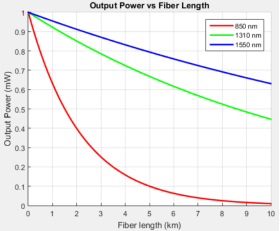
The simulation of wavelength-dependent attenuation in optical fibers produced clear and consistent results. The output optical power and the corresponding attenuation were calculated for three standard wavelengths: 850 nm, 1310 nm, and 1550 nm, along a fiber length of 10 km.
4.1 Output Power
The normalized output power decreases exponentially with fiber length for all wavelengths. As expected from the theoretical model, shorter wavelengths experience higher power loss. For example, after 10 km of propagation:
Table 2.
Output Power. Output Power. Output Power. Wavelength | Output Power |
850 nm | 0.13 |
1310 nm | 0.57 |
1550 nm | 0.63 |
The decrease is strongest at 850 nm due to Rayleigh scattering, while 1550 nm shows the lowest loss.
4.2. Attenuation Coefficient
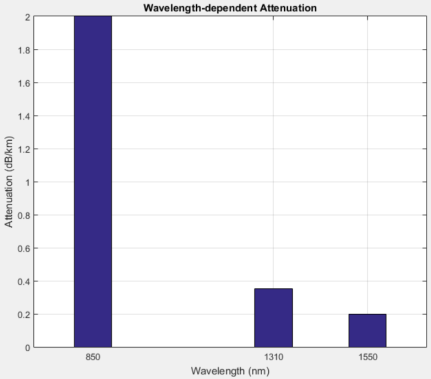
Attenuation was computed in using the standard logarithmic relation. The results clearly demonstrate the dependence of attenuation on wavelength:
Table 3.
Attenuation Coefficient. Attenuation Coefficient. Attenuation Coefficient. Wavelength | Attenuation () (dB/km) |
850 nm | 2.0 |
1310 nm | 0.35 |
1550 nm | 0.20 |
4.3. Graphical Representation
The attenuation as a function of wavelength is illustrated in
Figure 1. The curve shows a sharp increase in attenuation at shorter wavelengths, confirming the dominance of Rayleigh scattering at 850 nm. Attenuation decreases significantly at 1310 nm and reaches a minimum at 1550 nm, which aligns with standard low-loss transmission windows in optical fiber communications.
Figure 1. Simulated output power vs fiber length.
The
Figure 2 illustrates the wavelength-dependent attenuation of the optical fiber. The bar chart clearly shows that the highest attenuation occurs at 850 nm, with a value of 2
, while 1310 nm and 1550 nm exhibit significantly lower attenuation of 0.35
and 0.2
, respectively. This trend confirms the theoretical expectation that shorter wavelengths suffer higher losses due to Rayleigh scattering, whereas longer wavelengths, particularly 1550 nm, provide minimal loss and are therefore preferred for long-distance optical transmission. The comparison highlights the importance of wavelength selection in the design of efficient fiber optic communication systems.
5. Discussion
The results obtained from the MATLAB simulations clearly demonstrate the dependence of optical fiber attenuation on wavelength. Both the output power decay (
Figure 1) and the wavelength-dependent attenuation (
Figure 2) are consistent with theoretical expectations derived from the mathematical model presented in Section 3.
5.1. Comparison with Theory
The higher attenuation at 850 nm observed in the simulations is primarily due to Rayleigh scattering, which varies inversely with the fourth power of wavelength (
).
| [5] | M. N. Islam, “Rayleigh scattering in optical fibers,” J. Lightwave Technol., vol. 5, no. 4, pp. 718–723, Apr. 1987.
https://doi.org/10.1109/JLT.1987.1075481 |
| [6] | D. Marcuse, Theory of Dielectric Optical Waveguides, 2nd ed., San Diego, CA, USA: Academic Press, 1991. |
[5, 6]
This explains the rapid decrease in output power over the fiber length at shorter wavelengths. In contrast, the 1310 nm and 1550 nm wavelengths experience significantly lower scattering losses, resulting in higher transmitted power and lower attenuation. The simulation results closely match typical literature
| [1] | G. P. Agrawal, Fiber-Optic Communication Systems, 5th ed., New York, NY, USA: Wiley, 2012. |
| [2] | J. M. Senior, Optical Fiber Communications: Principles and Practice, 3rd ed., Upper Saddle River, NJ, USA: Pearson, 2009. |
| [5] | M. N. Islam, “Rayleigh scattering in optical fibers,” J. Lightwave Technol., vol. 5, no. 4, pp. 718–723, Apr. 1987.
https://doi.org/10.1109/JLT.1987.1075481 |
| [6] | D. Marcuse, Theory of Dielectric Optical Waveguides, 2nd ed., San Diego, CA, USA: Academic Press, 1991. |
| [13] | S. R. Kumar, R. K. Varshney, and A. Kumar, “Wavelength-dependent attenuation in silica optical fibers: Simulation study,” Optik, vol. 124, no. 19, pp. 4145–4152, 2013.
https://doi.org/10.1016/j.ijleo.2013.01.048 |
[1, 2, 5, 6, 13]
values for silica fibers, with attenuation of approximately 2
at 850 nm, 0.35
at 1310 nm, and 0.2
at 1550 nm.
| [11] | E. Desurvire, Erbium-Doped Fiber Amplifiers: Principles and Applications, 2nd ed., New York, NY, USA: Wiley, 2002.
https://doi.org/10.1002/0471223899 |
| [13] | S. R. Kumar, R. K. Varshney, and A. Kumar, “Wavelength-dependent attenuation in silica optical fibers: Simulation study,” Optik, vol. 124, no. 19, pp. 4145–4152, 2013.
https://doi.org/10.1016/j.ijleo.2013.01.048 |
| [15] | MathWorks, MATLAB R2025a Documentation, The MathWorks Inc., Natick, MA, USA, 2025.
https://www.mathworks.com |
[11,13, 15]
These findings confirm the validity of the exponential decay model and the assumptions regarding material and scattering contributions.
| [2] | J. M. Senior, Optical Fiber Communications: Principles and Practice, 3rd ed., Upper Saddle River, NJ, USA: Pearson, 2009. |
| [12] | K. Okamoto, Fundamentals of Optical Waveguides, 2nd ed., San Diego, CA, USA: Academic Press, 2006.
https://doi.org/10.1016/B978-0-12-525096-2.X5000-1 |
| [14] | A. D. Ellis and F. C. G. Gunning, “Spectral efficiency limits in optical fiber transmission,” J. Lightwave Technol., vol. 27, no. 22, pp. 3984–3998, Nov. 2009.
https://doi.org/10.1109/JLT.2009.2039464 |
[2, 12, 14]
.
5.2. Implications for Fiber Optic Communication
The study highlights the practical importance of wavelength selection in optical communication systems. The low attenuation observed at 1550 nm explains its widespread use in long-haul networks, particularly when combined with optical amplification technologies. Medium-distance links
| [11] | E. Desurvire, Erbium-Doped Fiber Amplifiers: Principles and Applications, 2nd ed., New York, NY, USA: Wiley, 2002.
https://doi.org/10.1002/0471223899 |
| [14] | A. D. Ellis and F. C. G. Gunning, “Spectral efficiency limits in optical fiber transmission,” J. Lightwave Technol., vol. 27, no. 22, pp. 3984–3998, Nov. 2009.
https://doi.org/10.1109/JLT.2009.2039464 |
[11, 14]
often employ the 1310 nm window to balance low attenuation with minimal chromatic dispersion. Short-distance multimode fiber systems still rely on 850 nm sources due to cost and availability, despite higher attenuation. Therefore, understanding the relationship between wavelength and attenuation is essential for optimizing fiber link design and ensuring signal integrity over various transmission distances.
5.3. Limitations and Future Work
Although the simulation approach provides clear insight into wavelength-dependent attenuation, it assumes idealized conditions, including uniform fiber characteristics, negligible connector losses, and constant environmental conditions. Future work could include the effects of bending, splicing losses, and temperature variations to better replicate real-world fiber optic networks. Additionally, experimental validation of these results using laboratory measurements would further strengthen the findings and provide a practical reference for system designers.
5.4. Summary of Key Observations
1) Shorter wavelengths (850 nm) exhibit the highest attenuation, limiting their use in long-distance communications.
2) Longer wavelengths (1310 nm and 1550 nm) offer minimal losses, with 1550 nm being optimal for high-performance long-haul networks.
3) The simulation results align closely with theoretical predictions, validating the MATLAB model and the assumptions made for this study.
| [1] | G. P. Agrawal, Fiber-Optic Communication Systems, 5th ed., New York, NY, USA: Wiley, 2012. |
| [2] | J. M. Senior, Optical Fiber Communications: Principles and Practice, 3rd ed., Upper Saddle River, NJ, USA: Pearson, 2009. |
| [5] | M. N. Islam, “Rayleigh scattering in optical fibers,” J. Lightwave Technol., vol. 5, no. 4, pp. 718–723, Apr. 1987.
https://doi.org/10.1109/JLT.1987.1075481 |
| [14] | A. D. Ellis and F. C. G. Gunning, “Spectral efficiency limits in optical fiber transmission,” J. Lightwave Technol., vol. 27, no. 22, pp. 3984–3998, Nov. 2009.
https://doi.org/10.1109/JLT.2009.2039464 |
| [15] | MathWorks, MATLAB R2025a Documentation, The MathWorks Inc., Natick, MA, USA, 2025.
https://www.mathworks.com |
[1, 2, 5, 14, 15]
6. Conclusion
This study investigated the effect of optical wavelength on signal attenuation in optical fibers using MATLAB simulations. The results demonstrate a clear dependence of attenuation on wavelength, with higher losses at shorter wavelengths (850 nm) and minimal attenuation at longer wavelengths (1550 nm). The output power decay along the fiber and the computed attenuation coefficients align closely with theoretical predictions based on Rayleigh scattering and material absorption.
The findings confirm that the 1550 nm wavelength band is optimal for long-distance optical communication due to its minimal attenuation, while the 1310 nm band provides a suitable compromise for medium-distance links. Shorter wavelengths, despite higher losses, remain relevant for cost-effective short-range multimode fiber systems.
Overall, this work highlights the importance of wavelength selection in the design and optimization of optical fiber communication systems. The MATLAB-based simulation approach offers a simple and reproducible method for evaluating fiber performance and understanding the physical mechanisms governing attenuation. Future work could incorporate experimental measurements and additional real-world factors, such as bending losses and environmental variations, to further validate the results.
Abbreviations
| WAVELENGTH |
| Fiber Length |
| Output Optical Power |
| Input Optical Power |
| Attenuation Coefficient (km-¹) |
| Attenuation (dB/km) |
| Decibel |
| Milliwatt |
| Nanometer |
Conflicts of Interest
The authors declare that they have no known financial or personal relationships that could have appeared to influence the work reported in this study. No funding, financial support, or material assistance from commercial or external organizations was received. The research was conducted independently, and the authors confirm that there are no competing interests related to the methods, results, or conclusions presented in this manuscript.
References
| [1] |
G. P. Agrawal, Fiber-Optic Communication Systems, 5th ed., New York, NY, USA: Wiley, 2012.
|
| [2] |
J. M. Senior, Optical Fiber Communications: Principles and Practice, 3rd ed., Upper Saddle River, NJ, USA: Pearson, 2009.
|
| [3] |
A. K. Ghatak and K. Thyagarajan, Introduction to Fiber Optics, Cambridge, UK: Cambridge University Press, 1998.
|
| [4] |
J. Hecht, Understanding Fiber Optics, 5th ed., Boston, MA, USA: Pearson, 2015.
|
| [5] |
M. N. Islam, “Rayleigh scattering in optical fibers,” J. Lightwave Technol., vol. 5, no. 4, pp. 718–723, Apr. 1987.
https://doi.org/10.1109/JLT.1987.1075481
|
| [6] |
D. Marcuse, Theory of Dielectric Optical Waveguides, 2nd ed., San Diego, CA, USA: Academic Press, 1991.
|
| [7] |
S. O. Kasap, Optoelectronics and Photonics: Principles and Practices, 2nd ed., Upper Saddle River, NJ, USA: Pearson, 2013.
|
| [8] |
P. E. Green, “Attenuation in optical fibers and its measurement,” Optical Engineering, vol. 24, no. 3, pp. 345–350, 1985.
https://doi.org/10.1117/12.7973496
|
| [9] |
H. Kogelnik and T. Li, “Laser beams and resonators,” Applied Optics, vol. 5, no. 10, pp. 1550–1567, Oct. 1966.
https://doi.org/10.1364/AO.5.001550
|
| [10] |
R. Kashyap, Fiber Bragg Gratings, 2nd ed., San Diego, CA, USA: Academic Press, 2009.
https://doi.org/10.1016/B978-0-12-372579-0.X0001-4
|
| [11] |
E. Desurvire, Erbium-Doped Fiber Amplifiers: Principles and Applications, 2nd ed., New York, NY, USA: Wiley, 2002.
https://doi.org/10.1002/0471223899
|
| [12] |
K. Okamoto, Fundamentals of Optical Waveguides, 2nd ed., San Diego, CA, USA: Academic Press, 2006.
https://doi.org/10.1016/B978-0-12-525096-2.X5000-1
|
| [13] |
S. R. Kumar, R. K. Varshney, and A. Kumar, “Wavelength-dependent attenuation in silica optical fibers: Simulation study,” Optik, vol. 124, no. 19, pp. 4145–4152, 2013.
https://doi.org/10.1016/j.ijleo.2013.01.048
|
| [14] |
A. D. Ellis and F. C. G. Gunning, “Spectral efficiency limits in optical fiber transmission,” J. Lightwave Technol., vol. 27, no. 22, pp. 3984–3998, Nov. 2009.
https://doi.org/10.1109/JLT.2009.2039464
|
| [15] |
MathWorks, MATLAB R2025a Documentation, The MathWorks Inc., Natick, MA, USA, 2025.
https://www.mathworks.com
|
Cite This Article
-
-
@article{10.11648/j.awcn.20261101.11,
  author = {Randriana Heritiana Nambinina Erica and Ando Nirina Andriamanalina},
  title = {Analysis of Optical Fiber Attenuation as a Function of Wavelength},
  journal = {Advances in Wireless Communications and Networks},
  volume = {11},
  number = {1},
  pages = {1-6},
  doi = {10.11648/j.awcn.20261101.11},
  url = {https://doi.org/10.11648/j.awcn.20261101.11},
  eprint = {https://article.sciencepublishinggroup.com/pdf/10.11648.j.awcn.20261101.11},
  abstract = {Optical fiber attenuation is a fundamental parameter that determines the efficiency and reliability of optical communication systems. Understanding how attenuation varies with transmission wavelength is essential for optimizing fiber optic links, particularly in long-distance and high-capacity networks. This study presents an experimental investigation of wavelength-dependent attenuation in optical fibers, focusing on commonly used telecommunication windows at 850 nm, 1310 nm, and 1550 nm. The experimental setup consists of an optical fiber link, optical sources operating at the selected wavelengths, and a calibrated optical power meter. For each wavelength, the input optical power and the output power after propagation through a fixed length of optical fiber were measured. The attenuation coefficient was then calculated in decibels per kilometer using standard logarithmic relations. Care was taken to minimize connector and coupling losses in order to ensure measurement consistency. The results reveal a clear dependence of optical attenuation on wavelength. Higher attenuation values were observed at 850 nm, primarily due to increased Rayleigh scattering effects at shorter wavelengths. At 1310 nm, the attenuation was significantly reduced, corresponding to one of the low-loss transmission windows of silica fibers. The lowest attenuation was recorded at 1550 nm, confirming this wavelength band as the most suitable for long-distance optical transmission. The experimental findings are in good agreement with theoretical expectations related to material absorption and scattering mechanisms in optical fibers. This study highlights the importance of wavelength selection in fiber optic communication system design. The simplicity of the experimental approach makes it suitable for educational laboratories and preliminary performance evaluations, while the results provide practical insight into the physical mechanisms governing optical losses. Overall, the work confirms that operating at longer wavelengths significantly improves transmission efficiency and supports the widespread use of the 1310 nm and 1550 nm bands in modern optical networks.},
 year = {2026}
}
 Copy
|
Copy
|
 Download
-
TY  - JOUR
T1  - Analysis of Optical Fiber Attenuation as a Function of Wavelength
AU  - Randriana Heritiana Nambinina Erica
AU  - Ando Nirina Andriamanalina
Y1  - 2026/01/19
PY  - 2026
N1  - https://doi.org/10.11648/j.awcn.20261101.11
DO  - 10.11648/j.awcn.20261101.11
T2  - Advances in Wireless Communications and Networks
JF  - Advances in Wireless Communications and Networks
JO  - Advances in Wireless Communications and Networks
SP  - 1
EP  - 6
PB  - Science Publishing Group
SN  - 2575-596X
UR  - https://doi.org/10.11648/j.awcn.20261101.11
AB  - Optical fiber attenuation is a fundamental parameter that determines the efficiency and reliability of optical communication systems. Understanding how attenuation varies with transmission wavelength is essential for optimizing fiber optic links, particularly in long-distance and high-capacity networks. This study presents an experimental investigation of wavelength-dependent attenuation in optical fibers, focusing on commonly used telecommunication windows at 850 nm, 1310 nm, and 1550 nm. The experimental setup consists of an optical fiber link, optical sources operating at the selected wavelengths, and a calibrated optical power meter. For each wavelength, the input optical power and the output power after propagation through a fixed length of optical fiber were measured. The attenuation coefficient was then calculated in decibels per kilometer using standard logarithmic relations. Care was taken to minimize connector and coupling losses in order to ensure measurement consistency. The results reveal a clear dependence of optical attenuation on wavelength. Higher attenuation values were observed at 850 nm, primarily due to increased Rayleigh scattering effects at shorter wavelengths. At 1310 nm, the attenuation was significantly reduced, corresponding to one of the low-loss transmission windows of silica fibers. The lowest attenuation was recorded at 1550 nm, confirming this wavelength band as the most suitable for long-distance optical transmission. The experimental findings are in good agreement with theoretical expectations related to material absorption and scattering mechanisms in optical fibers. This study highlights the importance of wavelength selection in fiber optic communication system design. The simplicity of the experimental approach makes it suitable for educational laboratories and preliminary performance evaluations, while the results provide practical insight into the physical mechanisms governing optical losses. Overall, the work confirms that operating at longer wavelengths significantly improves transmission efficiency and supports the widespread use of the 1310 nm and 1550 nm bands in modern optical networks.
VL  - 11
IS  - 1
ER  -
Copy
|
Download






 Share This Article
 Twitter
 Linked In
 Facebook